This page is Bobby Approved.
[Click here for the Graphics Version of this site]
Sensory problems and peculiarities are often reported by Aspies.
SID is a neurological condition which can occur on it's own, but many AS people report having at least some of the symptoms, and it can of course occur alongside autism too.
The process of receiving and organising sensory information in the brain is disrupted, sometimes resulting in over or under stimulation. The brain may be receiving sensory information inconsistently, or it may be organising it incorrectly, or it may not even receive it at all in areas where there is a disconnection of the neuron cells.
This manifests in some people as being over sensitive to everything, in others as being under sensitive to everything, but it can also be a combination of both, different for each sense.
The three main consequences of this are inappropriate responses or lack of response, avoidance of distraction or overload by avoiding stimulation, and/or seeking out stimulation or self stimulation.
Symptoms / Characteristic Behaviours
Vision
Bright lights uncomfortable / dim lights or darkness preferable.
Disorientated in environments rich with visual stimulation.
Plays with lights and shiny, reflective, or brightly coloured items.
Staring or fixating on patterns or objects.
Hearing
Repetitive humming or singing or loud outbursts of meaningless noise.
Trouble following conversation in groups or noisy environments.
Discomfort created by loud or low frequency noise.
Delayed or lack of response or over reaction to sudden noises.
Smell / Taste
Over reaction to smells, especially ones no one else is able to detect.
Prefers to eat bland food, and fussy about texture.
Chews or sucks non food items past age when expected.
Fascination with perfumes and / or how people smell.
Touch
Unusually high or low pain tolerance.
Highly sensitive to temperature.
Strong preference for gentle / feather touch or pressure / firm touch.
Fussy about how clothes or bed sheets feel against skin.
Listed above are just some of the sorts of symptoms people report, but there are many more. One I've heard people say about and have experienced myself is sensitivity to changes in barometric pressure, but I don't know what 'sense' you would list that under.
Self stimulation, Stims and Stimming
Self stimulation is a response to times of high or low arousal as well as being related to various emotional states such as feeling frustrated, nervous, anxious, bored, etc. and it can be either calming or arousing.
A stim is an activity that serves this purpose, usually a repetitive mannerism. Examples would be rocking, spinning, arm/hand movements, head movements, head hitting, pacing, humming, making noises, banging things, thumb sucking, hair chewing, hair or finger sniffing, staring etc.
While stimming can be self injurious or appear that way, not all self injurious behaviour is stimming. Hurting yourself can be a form of displaced aggression towards oneself and could be a sign of depression.
Sensory Overload
When the brain becomes over stimulated it can go into overload. The type of sensations that could cause this would be things like bright lights or flashing lights, loud or conflicting noises, strong smells, pressing up against other people in a crowd, being surrounded by moving faces or objects, or any confusing or overwhelming sensory environments where any number of these things could be occurring at the same time.
I find that it can be made much worse when the environment is unfamiliar and also that my emotional state makes a big difference. If I am feeling tired, sad or under stress to begin with then sensory overload is almost certain to occur and much worse than when I am feeling better.
The overload can manifest itself as anything from something as mild as a heavy feeling that you can't go on and need to get away to being as severe as becoming almost catatonic. It could be accompanied by headaches or feelings of panic and disorientation. You may be unresponsive or confused. There is a distinct sensation of slipping away from the world and the brain feels like it is shutting down.
Other sensory problems that can be associated with autism...
Synaesthesia (also known as cross sensory perception) is when input from one sense is interpreted by another e.g. seeing sound, tasting colour, or hearing light.
Scotopic Sensitivity Syndrome (Irlen Syndrome) is thought to be a problem with how the visual cortex processes information, resulting in visual problems, light sensitivity and inaccurate depth perception. This can result in literacy problems, clumsiness and headaches. Treatment involves the use of Irlen lenses, which reduce light sensitivity and perceptual distortions allowing correct interpretation of visual stimuli. Approximately 12% of the population are believed to be affected to some degree.
10% of the population are thought to have a degree of dyspraxia... 2% of them severely.
Some of the symptoms of dyspraxia can also fall under the description of sensory integration dysfunction, but because it is also treated as a condition in it's own right I am describing it separately here.
Vestibular System
The vestibular system refers to a collection of structures within the inner ear that detect movement and changes in the position of the head. It can be hypersensitive or hypo-reactive, that is the child can either be very sensitive and have trouble with movement and balance and appear clumsy or they may actively seek out intense sensory experiences to try and stimulate their vestibular system like jumping and spinning (stims). This is often interpreted as clumsiness, laziness or hyperactivity.
Proprioceptive System
The proprioceptive system provides feedback from the muscles, joint and tendons to provide a person with a subconscious awareness of their body position. It is necessary for fine motor movements such as writing and fastening buttons as well as the automatic repositioning of the body during tasks like sitting or climbing stairs.
When it's not working properly there can be a tendency to fall, odd posture, and problems with fine motor skills, for example eating can be sloppy. There can be a resistance to learning new motor activities. This is often interpreted as clumsiness or laziness.
Praxis / Motor Planning
This is the ability to plan and carry out motor tasks. It depends on accurate feedback and processing by the sensory systems. Without effective motor planning movements can be poorly timed and misjudged. This is often interpreted as clumsiness.
Agnosia is when you can sense objects and forms but are unable to consciously recognise and interpret their meaning. Prosopagnosia (face blindness) and Topographical Agnosia are often reported by people with Asperger syndrome.
Prosopagnosia is an inability to recognise peoples faces. You can usually still tell the difference between faces and are still aware that you are actually looking at a face... it is not a problem with vision, it is a problem with interpreting and recognising visual information. It is not the same as just having trouble remembering names or forgetting people you have only just met or do not know very well.
If you are face blind then you may not even recognise people you know well like friends or family, especially if they have changed something about themselves like a new hair cut or outfit, or if they are in an unfamiliar context like in the street instead of at work or home. You may not even recognise yourself in a mirror until you realise that is what you are looking at.
Difficulty here may be compensated for by relying on information other than faces to recognise people with such as hair colour/style, sound of voice, body shape, clothing or even just the context of the situation (who you expect it to be). You may not even be aware of the extent to which you have difficulty recognising faces because you compensate so well.
In some cases repeated exposure to a persons face seems to help increase recognition, but this may just be a result of finding other ways to recognise them.
Topographical Agnosia is when people have trouble finding there way around places even if they know them because they are unable to recognise the features around them that tell them where they are and where to go. It is not the same as just forgetting the way to go or getting lost in a new place. There is difficulty finding your way around places that should be familiar.
Aspies can be particularly vulnerable to stress.
How much stress you have experienced is traditionally measured by assigning points to particularly stressful events such as moving house or bereavement, and then totalling up how much stress you have had during the last year. This system however does not take account of the fact that 10% of people have low stress tolerance, and require a lot less to happen before they become stressed. Also, severe stress can just as easily be caused by a constant build up of minor stresses as it can a few big events or changes.
If you have lived every day of your whole life under stress you may not even appreciate how much stress you are under because it just feels normal.
Some examples of things that can cause stress for Aspies are...
Sensory discomfort.
Social difficulties or bullying.
Trouble getting organised.
Coping with change.
Stress is the bodies response to an event or situation which is perceived as threatening. In a natural environment stress is part of the fight or flight response and serves and important purpose. The three main chemicals that control this response in the body are Noradrenalin, Adrenaline and Cortisol.
Noradrenalin is your fight chemical and is related to aggression and anger. When your body produces a large increase in Noradrenalin in response to something some of the effects it has on your body include muscle tension, teeth clenching, blood vessels constricting, hands and feet sweating, and pupils dilating.
Adrenaline is your flight chemical and is related to escape and running away. When your body produces a large increase in Adrenaline in response to something some of the effects it has on the body include heart racing or palpitations, nervous feeling in tummy, cold sweats, and feelings of insecurity, anxiety, uncertainty, and worry.
Cortisol is your surrender chemical and is related to loss of control and submission. When your body produces a large increase in Cortisol in response to something some of the effects it has on the body include feelings of failure, despair, anxiety and depression. Large amounts of Cortisol also suppress the immune system.
Excessive, frequent, and prolonged exposure to the stress response can be harmful to the body. Unlike wild animals we do not often have the option to physically attack or run away. We don't get that release. Instead we get miserable and sick. It has been estimated that 75% of illness reported to GP's is stress related. Stress has been linked with heart disease, high blood pressure, migraine, indigestion, nausea, heartburn, stomach ulcers, irritable bowl, diarrhoea, constipation, headaches, neck and back pain, cancer, arthritis, allergies, colds and flu, asthma, skin disorders, obesity, anorexia, anxiety, addiction, drug abuse, sleep disorders, and disruption of the menstrual cycle.
If you see a doctor about stress most of them will simply offer you tranquilisers, but you should be cautious before resorting to such things. Even readily distributed prescription drugs can be highly addictive and have harmful side effects on the central nervous system, cause a severe deadening of the emotions, alter sleep patterns and reduce the amount of dream sleep you experience, as well as interact with other every day drugs you might take in ways you might not want them to.
There are also natural alternative remedies, but it is hard to get trustworthy and reliable medical advice regarding their use. It can be very much a case of trial and error, trying to find what works for you. The only natural remedy I personally found effective against stress was Kava Kava, but sadly this was made illegal earlier this year on the grounds that it had not been properly tested as a drug. A rather weak case considering it has been used safely for thousands of years and at the very least has never be shown to produce anything like the harmful side effects of prescription tranquilisers.
It is worth remembering that stress 'remedies', be they alternative or mainstream, are not a complete and final solution to the problem. It is the cause of the stress, not the stress itself, which ultimately needs to be addressed.
Mild stress can be reduced by making time for relaxation.
Some of the things you could do to combat stress include...
Making time for yourself - Take time off work if you need to.
Meditation
Floatation
Relaxing music
Yoga
Massage
Exercise
Acupuncture
Aromatherapy
Getting enough quality sleep.
Eating well, avoiding binging on chocolate, coffee, cigarettes, alcohol etc.
Building a sensory retreat, such as your bedroom, tailor made to your sensory requirements, where you can escape to.
Avoid situations that cause you stress as much as possible.
The best way to relax is to avoid getting stressed in the first place. Some stress is unavoidable in life, and some isn't. Learn to say NO. Other people will dismiss your stress when it is inconvenient to them, but you should put your health and happiness first. They cannot possibly know what it is like to experience the world being you.
When your stress is severe it may be impossible to achieve a relaxed state. Sometimes stress gets so bad that you can't cope and can't be expected to carry on trying to function at an effective level. This is nothing to be ashamed of and is much more common than you think. Don't wait until you reach breaking point before you ask for help.
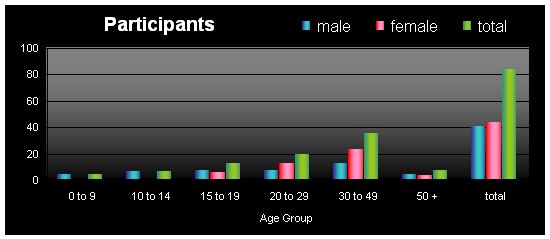
83 people responded to the stress survey throughout March and April 2003, which may not sound like very many, but it was more than I hoped for, so a big thank you to everyone who took part.
It goes without saying that this survey was far from scientific, and it's purpose was never to prove anything... It was just a curiosity.
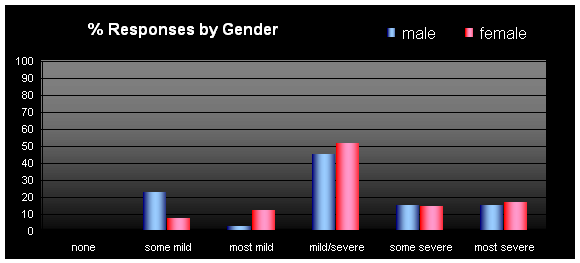
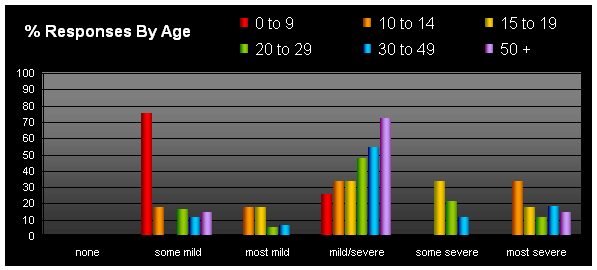
For the sake of making the results a bit more interesting to look at I have made graphs that compare by age and by gender, and while some differences are interesting and look like they might be significant, some are misleading. In particular, only 4 people under the age of 10 took part, so it is not worth comparing them to the other age groups. Also, the differences that appear between genders could likely be caused not by any actual gender difference among people with AS but instead by the gender expectations imposed on them by society.
There are some general things I can report however from the results. On average most of the Aspies who responded reported that they were under some degree of stress most of the time. The causes of stress varied greatly, but the most commonly reported was being misunderstood. Of the possibly stress related mental and physical health issues I asked about, most of them were reported in between 30% to 70% of responses.
How these results would compare to a survey of neurotypical people I cannot know. We live in a time when stress and stress related illness are common in all areas of society. What worries me is that the things that cause stress for Aspies and the types of things that Aspies need to do to relieve stress are different to the majority, so our issues are not addressed and there is nowhere we can turn for help and advice.
I think it interesting that more female aspies than male took part, since males outnumber females on the autistic spectrum by at least 4 to 1.
[View Graph of Responses by Gender]
The responses of stress levels people had to choose from were as follows...
I suffer with severe stress most of the time.
I suffer with severe stress some of the time.
I suffer with mild stress most of the time and severe stress occasionally.
I suffer with mild stress most of the time.
I suffer with mild stress some of the time.
I never get stressed.
[View Graph of Responses by Age]
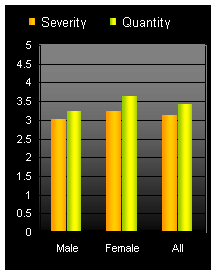
The average stress levels were calculated by giving the responses offered values from 0 to 5 first ranked by the severity of stress reported and second by the whether stress was being experienced just some of the time or most of the time, 0 being the lowest and 5 the highest.
[View Graph of Severity/Quantity of Stress by Age]
[View Graph of Severity/Quantity of Stress by Gender]
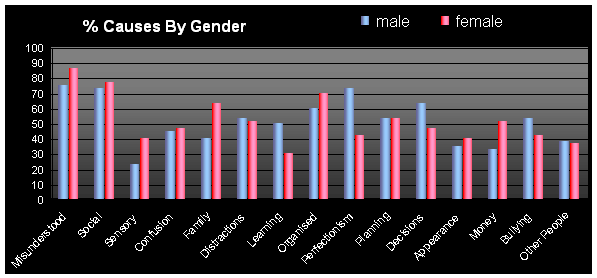
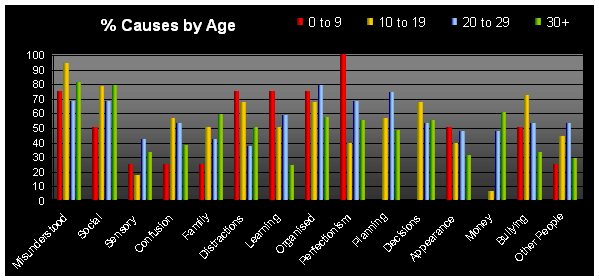
People were given a list of 15 things and asked to select which of them contributed to any stress they experienced. The options were... being misunderstood, social situations and difficulties, Sensory problems, feeling lost and confused, family, constant distractions, embarrassment at learning difficulties, trouble getting organised, being a perfectionist, planning for the future, making decisions, concern about appearance, worrying about money, bullying, and other peoples problems...
[View Graph of Causes by Gender]
Above and below are graphs that show the percentage of people in each category that selected each option e.g. Just over 70% of the males who took part reported that their perfectionism caused them stress while only just over 40% of the females who took part did.
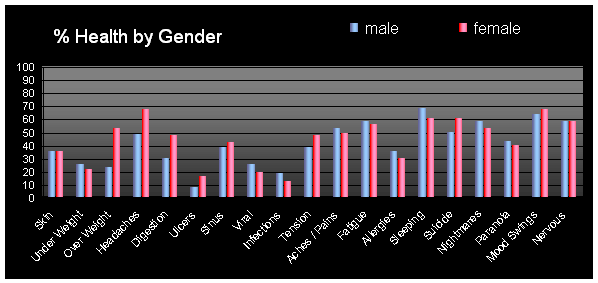
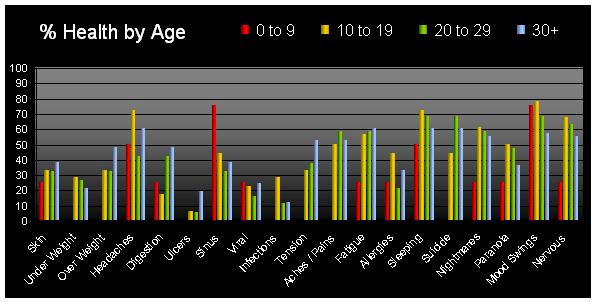
People were also given a list of 19 mental and physical health problems and asked to select which of them they experienced difficulty with. The options were... skin disorders, eating disorder/being underweight, obesity/being overweight, headaches, diarrhoea/constipation, ulcers, sinus problems/colds, infections, muscular tension, general aches and pains, constant fatigue, allergies/asthma, sleeping difficulty, thoughts of suicide or despair, nightmares/anxiety dreams, paranoia, mood swings, and nervous habits e.g. nail biting.
[View Graph of Health by Gender]
Above and below are graphs that show the percentage of people in each category that selected each option e.g. almost 70% of 20 to 29 year olds reported feelings of suicide or despair.
It seems more or less commonly accepted that many, if not all, autistic brains employ a visual form of cognition (referred to as "Thinking in Pictures" by Temple Grandin). If you are not sure what I mean by being a visual thinker, the best description I have found is that given in the following article by Temple Grandin ['My Experiences with Visual Thinkingg, Sensory Problems, and Communication Difficulties']. The bit on visual thinking is about half way through so you might want to just scroll down to it.
I am very interested to know if it is really the case that autistic people are visual thinkers, so I have been asking the question 'Are you a visual thinker?' on the site for the last couple of months, and I have had 75 responses.
The results surprise me, because I can't believe that 25% aren't visual thinkers, or at least don't consider themselves to be. I think it is interesting that just as many neurotypical people as autistic spectrum people identified with the description of visual thinking as given by Temple Grandin.
I should make myself clear... I'm not saying that I don't think autistic people are visual thinkers, whatever they consider the definition of that to be. My concern is that we are so eager to define ourselves by how our minds work that we are making unjustified assumptions.
Humans rely heavily on the sense of sight. I would think it was very unusual if we did not visualise a great many of our thoughts, or at least have the ability to do so if we chose.
I think there are lots of different ways to think and I think most people employ all or a combination of some of them. Some people will be weaker in some areas and stronger in others. Autistic people may well often be stronger visual thinkers than most, perhaps compensating for being weaker in other forms of thinking such as verbal or language based perhaps.
I think one of the real problems is that we have no vocabulary to describe ways of thinking. Instead we must borrow words from the physical world, such as 'seeing' and 'hearing', and because our own thinking is all we know, we have nothing to compare it to... a bit like trying to describe what 'big' is in a world where everything is the same size.
Just for fun, here is a quiz that attempts to find out what type of 'thinker' you are... [BBCi - Leonardo - Thinker quiz]
Some people think depressive thinking is inevitable with AS, but I refuse to accept that.
People with AS are vulnerable to clinical depression because of the stress, isolation and victimisation we sometimes experience, and there is a possibility we have a pre-disposition to it, but I don't think that means we are inevitably and inescapably depressed all the time. Speaking for myself, I've had clinical depression... it came and it went. Some people could interpret the way I am now as mildly depressed at times, but no where near in the same league. As I write this I feel perfectly calm and content and even quite happy because I am doing something I enjoy... it is a Sunday morning and the sun in shining and life is good. If you are depressed you cannot feel emotions like these. When you are depressed everything just feels... dead.
Depression is a clinical condition caused by a neurochemical or hormonal imbalance. It is not the same as self pity, just feeling a bit down or going through a bad patch. When the brain responds to upset and trauma in a healthy way it works its way through the experience and recovers. Sometimes the brain gets sort of stuck and doesn't get better like it should. It could start off having been a healthy response to something bad that happened or is happening, or it may occur without anything obviously bad having happened at all. In a way, the mind gets in a loop of negative thinking... you can't see beyond the way you are feeling and the future just seems black. You might be able to sense that your feelings are out of proportion to the circumstances, but you can not shake it off and cheer up. This just makes you feel guilty, and feeds the self hate that can become the driving force of depression.
Some of the symptoms of depression...
You have feelings of misery and despair.
You feel like you hate yourself.
You lack energy.
You lack motivation.
You suffer from stress, anxiety, or feelings of panic.
You don't feel like socialising.
You find it hard to concentrate or think clearly.
You feel guilty.
You feel like a failure.
You think you are evil.
You feel like a burden to others.
You sometimes feel that life isn't worth living.
You see the future as black and hopeless.
You feel like everything is futile and can't find pleasure in anything.
You feel irritable or angry more than usual.
You lack confidence.
You may go over and over the past and things that you feel went wrong, often blaming yourself.
You feel that life is unfair.
You are having difficulty sleeping and may be troubled by nightmares or anxiety dreams.
You may be crying a lot.
You may have aches and pains.
You may be off sex.
You may be off food and losing weight, or comfort eating and gaining weight.
You feel like you hate your body, feel disgusting or imagine that you are rotting.
You feel like you are dead.
You may be contemplating suicide.
You might be hurting yourself.
If you think that you might have depression then you should make an appointment to see your doctor. They will usually offer you anti-depressants or counselling or both.
If I ever faced the choice again I would not take anti-depressants unless I really felt there was no other way of getting me out of the depression and it was an emergency. Autistic people can be very sensitive to medications and react to them in unusual ways. While I was on them I had no personality and I was a giggling idiot. It felt like I was lost inside a cloud. They took away the pain of the despair, but they took the rest of me away with it. When I tried to come off them I fell straight back into severe, almost hysterical depression in just a matter of weeks, and then it took months before my mood levelled out again, with me most certainty hitting rock bottom before I started to make my way back up. The only reason I didn't go immediately back on the tablets was because I was in such a state in didn't even occur to me. In retrospect, taking the little red pills was just postponing dealing with how I felt, but I can't know for certain I would have survived without them at the time. The difference between then and now is, now I know I can.
There are other options like counselling and alternative medicine. If something isn't working for you don't be afraid to say. It is also very important that you tell who ever you see that you have Asperger's syndrome or think you do, if that is the case.
If you just need someone to talk to then you can contact [The Samaritans] in the UK on 08457 90 90 90. They will listen to you and take you seriously, but won't get emotionally involved like your family or friends. You may be surprised by just how helpful that is...
Only 3% of adults with Asperger's syndrome are said to live independently.
Independence is something that most people take for granted, but that doesn't mean it is easy for anybody. Very few people undertake the task entirely upon their own, often relying on a support network of friends and relations or sharing the responsibility with a spouse, partner, or house mate. Perhaps one of the difficulties for people with Asperger's is that we find it so hard to build these support networks and partnerships. If you already find it hard to get organized or if you worry and panic about things, the last thing you need is to be so isolated.
There are different degrees of independence of course, and people vary as to their potential to achieve them. No one can tell you what your potential is, you have to discover it for yourself.
The amount of times I've read so called 'caring professionals' telling parents and the general public how the outlook for our lives is 'grim' and how we can't hope to ever hold down a job or have a stable relationship. Presumably they think we can't read as well seen as they have never stopped to consider the impact on us of hearing such a thing. Personally speaking, I can live with disappointment but I can't live without hope.
The statistics here could well be misleading too. All they really tell us is that 97% of diagnosed adults are not independent, and seen as not being independent is probably one of the reasons why they got the diagnosis, it tells us nothing about the true ability or potential of Aspies in general. It takes no account of those people there may be who meet the diagnostic criteria but either do not want or need a diagnosis, or have never heard of Asperger's syndrome to even suspect they have it, the very reason for which could be that they are in fact reasonably independent.
Support and assistance are needed unquestionably, and an understanding of the difficulties and limitations of people with AS is very important too, but I don't think it is helpful to pre-judge peoples potential and to undermine their self confidence and esteem by having dangerously low expectations of them.
I think it is tempting for neurotypical people to assume that we are a bit simple minded because they judge us by their own standards of external appearances and behaviour. I think it is in error to have that attitude... most disrespectful in fact.
Having AS does not necessarily mean you are unfriendly or anti-social.
Aspies are quite capable of enjoying the company of others and like to talk and have fun sometimes just like anybody else. Despite this, attempts to socialise are often unsuccessful.
33% of autistic adults in the UK are said to have no social involvement.
This is for four main reasons.
Rejection
Lack of understanding of the social rules, body language and facial expressions, combined with lack of eye contact etc. Means that Aspies are sometimes perceived as weird eccentrics or seen as rude and unpleasant. Sometimes this results in active bullying and at other times in passive exclusion.
Stress
When you are aware you have social difficulties and you have trouble understanding and relating to people, socialising can be a very stressful activity. You can be filled with dread at the thought of doing anything that will involve communicating with other people, and may actively choose to avoid social situations.
Neglect
Socialising and making friends is not something that just happens... you do have to make at least a minimal amount of effort with people. Many Aspies will neglect to do this, sometimes because they do not know they need to or are expected to, and other times because they have higher priorities.
Desire
Many Aspies have interests, hobbies, activities or projects that they can lose themselves in quite happily. Given that most do not really enjoy idle chit chat or shallow gossip, and being with people is so stressful anyway, socialising often loses out to more pleasurable activities.
For some of the same reasons romantic relationships sometimes become a low priority too, but likewise, this does not mean that people with AS are not capable of or do not want to fall in love, far from it. Despite all the obstacles and difficulties some perfectly normal people can and do fall in love with people with AS and vice versa, and indeed some people with AS can have relationships with each other too.
However, I think a trap people should not fall into is that of thinking that people with AS will always just magically 'click' with each other, either in friendship or love, just because they both have AS. While the chances of mutual understanding are increased, the difficulties of AS don't go away.
The subtle ballet of verbal and nonverbal communication.
Nonverbal
Around 70% of all communication is non-verbal and is largely beyond our conscious control. Body language could be a facial expression or a movement or positioning of the body. The vast majority of people are walking around giving out the correct body language signals (even ones they would rather hide) and are also subconsciously interpreting other peoples body language all the time. It is not so easy for people with Asperger's Syndrome because it does not come naturally and instead must be learnt and concentrated on.
Tone of voice can be a problem for Aspies too. A flat or inexpressive intonation is a well known feature, but it could just as easily be a strange accent, trouble controlling volume, an exaggerated intonation, or even a habit of mimicking the voices and accents of other people. Understanding or even noticing subtle meaning in peoples tone of voice is difficult too, like appreciating sarcasm for example.
Neurotypical people subconsciously make judgments based on all this nonverbal evidence. For Aspies there is the constant risk of misunderstanding and being misunderstood.
Verbal
You would think verbal communication is under conscious control all of the time, but I'm not sure it always is, at least based on my experience. The majority of people do not stop to think... they seem to know more or less what they are required or expected to say. I listen to other people, I observe the type of things people say and the circumstances when they say them... some people don't ever seem to say anything original or honest. It is hard for me to mimic the way I see other people being because to me they sound very insincere, false and banal. That may not be the way they really are, but it is most definitely what I end up sounding like if I try and copy them.
I've spent a lot of my life thinking about these social rules everyone keeps talking about. Long before I had ever heard the phrase 'social rules' or knew about Asperger's I was aware that there were things I should be doing that I wasn't and things I was doing that I shouldn't, and whether I was supposed to be doing them or not, when I did them, I usually did them wrong. You see, you can't the learn the social rules because they don't often exist until you break them.
The best example I can think of to give of breaking a social rule is What to do when someone asks 'HOW ARE YOU?'
I learnt from experience and by listening to other people that I was supposed to reply 'FINE THANKS'. If someone asks me now the sounds enter my brain which interprets them and passes that on to the part of my brain which will formulate and produce my response... Within fractions of a second I will be well on my way to saying how I'm actually quite depressed because the gas bill was more than I expected and my period is giving me stomach cramps... a few more fractions of a second later the question will have filtered through to the part of my brain that realises to its horror that I was supposed to have simply responded 'fine thanks' and now I've made a terrible error and made the questioner feel embarrassed and uncomfortable (I do this a lot).
It is important to remember that the social rules are unwritten and are not really rules at all... if they were they would be easy enough to learn. Most of them occur in more complex situations than the simple example I gave above. The social rules are really more about the shared understanding that the majority of people experience with each other. What they call the social rules are not so much about the content of what you say and not always even about how you say it... it is all about WHY you said it.
The neurotypical way of communicating seems to be very goal orientated, beyond the simple purpose of sharing information. When people say things that are unexpected in the social context they need to question that persons motives. In the example I gave above, going into detail about how I was feeling was wrong, not because of some meaningless imaginary rule, but because the questioner could not understand my motive for giving such a reply. Very few neurotypical questions used in day to day speech are genuine attempts to solicit information. By and large, they have obscure social functions, such as maintaining friendly relations or telling people things without saying the words.
It is not about choice, it is about how the mind works. When I hear words, I hear the meaning of the words and little more than that. I have surprisingly little control over my honest and factual responses... they just happen. Neurotypical people filter both incoming and outgoing words through layers of body language, tone of voice, context, social status, relationships, possible motives, convention and mood until at last a little trickle of meaning reaches their brain, usually so diminished that they must project their own opinions and feelings on to it before it has any value. Ask someone to repeat back to you what was said a week, a day or an hour before and you will see this. What they say is what they eventually heard or meant, not what was actually said. It does seem to work for them though because with experience most of them seem to learn to compensate for all this confusion. I believe this skill is called emotional intelligence.
I am 26 years old and my name is Suzie. I was diagnosed with AS last year, but I have been this way all my life.
My favourite colour is purple, I like eating Chinese take away (but I always order exactly the same thing), I enjoy reading, and I am huge fan of 80's TV series The A-Team, but best of all I like doing things on my computer.
I'm good at lots of useless things and useless at almost everything that matters, but I cling to the hope the universe has some reason for having me in it.
I did well at school, despite being tortured nearly every day I attended from age 4 until 18. I was doing well at university too until the bullying and ostracism got so bad I dropped out. Having no words, and lets be honest, no excuse for my difficulties back then, I had no choice but to look for work to support myself.
Despite my intelligence I have only ever been able to get relatively low paid work that fails to take full advantage of my abilities, and I am yet to find anywhere in life where I have felt happy and able to cope with peoples expectations, so I move around a lot.
People are quite happy to think of me as odd, rude, eccentric, anti-social, awkward, a loner, miserable, weird, stuck up, stupid, or mean, but because I can walk and talk and look 'normal' most just can't accept that I have a disability... that I find things more difficult than them... So I've more or less stopped telling them. Trying to explain and trying to get them to accept me as I am is more difficult than just putting up with their misunderstanding and unfair judgement.
If it rained at playtime we would all be herded into a big concrete shed by the playground supervisors to sing counting songs like Ten Green Bottles and One Man Went To Mow. I always looked forward to rainy days. I enjoyed the counting songs. It was better than normal playtimes on dry days when I'd just walk about on my own watching other kids doing stuff and wondering why I didn't have things to do and games to play like they did, but not really caring.
One day, when I was five years old, I went into the rain shelter with the crowds of other kids as usual, but this time for some reason one of the supervisors was held up and we didn't start singing for a while. We were stood around waiting and I noticed some boys laughing at me and saying I must smell because I was stood alone with a big space all around me.
I had never noticed before. I knew I didn't smell, but they were right, I was the ONLY person stood alone. I had never noticed or minded being stood alone. Why would I need to be stood with someone? We were just singing... you don't need someone else to help you sing, you just stand there and do it. We were all stood in there together singing on our own as far as I was concerned. I had not been aware of the pairs and groups people formed within that.
I was quite shocked. Was this something I was supposed to have done that I forgot to do? I couldn't remember anyone telling me. I felt like I had done something wrong. I burst into tears. I tried to hold them in, but I couldn't stop myself. Suddenly I felt alone and vulnerable, and I had never felt that before.
I knew in that moment that I was too late. I had missed my chance. I had taken a different path to the other children around me and I was the only one on it. There was no turning back... I could feel it.
I didn't know where to begin making friends, but I felt so guilty and inadequate, I felt it was a matter of urgency that I did, for my own safety and happiness. I did try, I really did, I tried EVERYTHING. It never worked. If I had my life to live again I wouldn't bother. I am what I am.
I wish I could travel back in time and tell the little girl in the rain shelter that she hadn't done anything wrong. Some people are just supposed to be stood alone in this world. Only the best people, the strongest, bravest, cleverest people are picked for it, because they are the only ones who can handle it. She should never let anyone tell her different.
I was 17 before I realised this. I started referring to myself as socially disabled. I tried to explain to other people that I was just different and couldn't help it, but no one took me seriously. It was eight years later before I discovered Asperger's syndrome and was diagnosed. I would never have guessed. I thought I was the only one.
Sometimes, when people talk, I can hear the words, but my brain just can't make any sense of them. It's like hearing someone speak a foreign language. I struggle desperately to focus my concentration on what they are saying but I just can't catch hold of any solid meaning to grasp on to. They might as well be just going 'bla bla bla bla'.
The only thing worse than having to act deaf or stupid when it becomes apparent I've not taken in a single word that has been said to me, is the way people jump to conclusions about the expression on my face while they are talking. If I squint and my brow creases and I look pained it is because I am having genuine difficulty getting the parts of my brain responsible for comprehension to work and am feeling quite considerably distressed about it... it is not because I don't like you or what you are saying.
It seems to at least in some part be caused by sensory problems. I can't tune out background noise when people speak and it can make it extremely difficult to switch my brain on to understanding words when it's devoting most of its attention elsewhere, but there are other factors like the subject matter and how stressed or tried I am.
If this wasn't odds enough stacked against me when it comes to communicating, I also have the skipping rope phenomena to cope with. I'll try to explain... You know that game where two children turn a rope and a third child must 'jump in' and jump the rope for as long as they can and then 'jump out' gracefully without the rope ever having hit them. Well, that is what turn taking in conversation is like for me. I wait patiently to jump in but I can never see a good moment, so eventually I just go for it and interject, only to discover I got the timing wrong. My intrusion is rarely welcome and I don't often have anything to say that anyone actually wants to hear, so the conversation either stops dead or ignores me and keeps going... Just like a skipping rope hitting me and me getting all tangled up in it.
At first when people meet me they tell me I don't talk to people enough, but it's just that I'm scared to talk because it always goes wrong. In my early teens I almost stopped talking altogether in public because every time I opened my mouth to speak trouble followed. I remember over hearing one boy saying he thought I was weird because I just sat staring ahead in silence all the time, which surprised me because I hadn't expected anyone to notice. It's ironic really because when people do make me feel comfortable and like I don't have to worry about getting stuff the way they want or expect, I never stop talking.
Talking is very exhausting though. Normally I don't think in words like I am told other people do. I don't know that I would describe how I think as thinking in pictures either exactly, even though that forms part of it, it's more like thinking in structures and patterns... I can't think of any other way to describe it. It all happens so fast. I know a great many things instantly that it would take an hour to explain in words, and because the original thought was not in words I must turn it into words first, like painstakingly translating it into another language that works on a completely different system.
I end up having to use a lot of metaphors. I use what I call my non-time (time when I'm doing stuff that doesn't require my brain like walking down the street or watching TV or taking a shower) to go over my thoughts applying this translation process by imagining that I am talking. This way if I am ever called upon to say things to someone I will be able to just read out the pre-prepared and scripted speech from my brain. I have archives full of stuff I can say given the opportunity. Once you get me talking I tend to download this stuff at you almost without drawing breath just making minor modifications as I go.
There are just two problems. Firstly, what I have thought of doesn't always fit into the conversations I encounter during every day life, except I use it anyway because I can't think of anything else to say. This makes it look like I am thinking of random things and inappropriately saying them out loud, or sounds just plain eccentric, strange, and boring, but I cannot help myself, as aware as I have become of what it makes people think of me.
The second problem is all this imagining I am talking means sometimes I start to move my lips or think aloud or talk to myself without knowing it. People who pass me in the street may think I am mentally ill or on drugs, but I am not having delusions or hallucinations, it is just the way my brain has to work in order to communicate with language. It's always been that way.
When I was kid I would imagine I was presenting a television show in order to practice speaking my thoughts. I used to say them out loud all the time back then. I didn't realise people didn't like it or that I wasn't supposed to. Years later I was told that parents told their children to stay away from me because I was always talking to myself. I still don't see what the problem was to be quite honest. That seems like such a huge over reaction to something so harmless.
If you put me on the spot and ask me something unexpected that will require a constructed response in words, unless I can find something pre-prepared I can use, then I will often not be able to speak. I don't mean don't want to speak, I mean I really cannot speak. There are no words there to say. I might say nothing, ignore you, or just grin and shrug my shoulders. It doesn't mean I haven't understood or wasn't interested. I always make an effort with people I trust, but quite a lot of what comes out is nonsense or just dumb repetition of things I have heard other people say in real life or on television. That's why I try to steer conversation round to things I have stuff prepared on.
This isn't always good enough though. I do have to work, and the level of communication that sometimes demands means devoting intense mental effort to appearing more 'normal'. I call this 'masking'. Essentially it involves turning every available resource in my mind over to generating suitable responses... they are not my words. It all comes from memories and television and books... recycled information. It's faster and sounds more confident and friendly than my own speech. It takes a lot of concentration, so I can't do anything else or even answer questions at the same time. It is totally superficial. Nothing of me goes into it. I never choose to act like that, it just happens sometimes. My mind is put under unimaginable pressure to communicate in ways that do not come naturally to it and so it improvises and adapts. I cringe sometimes to hear myself quoting directly from an action hero or something in a movie... stuff that doesn't sound quite right coming from me. I try to laugh it off though. I think most people just assume I'm a bit eccentric.
It all sounds so ridiculous when I write it down here like this. Of course I hate it. It feels like I am screaming inside my head. If I had one wish, it would not be for money or beauty, though heaven knows I have neither and need both... my wish would be to live in a world where I could simply be myself. I can't, I have come to accept that. I have learnt to cope too well for my own good. I will spend the rest of my life being punished for having made that effort.
Play time was always a difficult time for me. Even before the bullying began, I had difficulty joining in with other children's games. I remember Jaws in particular. It was based on tag. All the kids in the playground would come and stand on a low wall and one person would be Jaws and stand out in front. There would be silence as everyone waited and the tension built, then they would shout 'Jaws!' and everyone would jump off the wall and run around. If Jaws tagged them they would stop and stand still with there legs apart. If someone crawled through their legs they could start moving again. The game was over when all but one person and Jaws were still running around. That person would win and get to be Jaws next.
I watched from in the background for a long time. I was the only kid not joining in because I had not been asked. I did not know that no one else was asked either and that they just joined in anyway. I never could understand how whole crowds of people could organise themselves like that without speaking a word. It was like a secret club and I wasn't a member. When I finally asked someone if I could join in they thought I was mad for asking.
I asked the rules. They told me the object of the game was not to get caught by Jaws. So, when all the kids jumped off the wall and started running around I ran off down the other end of the playground where no one was and hid behind a big flower pot... I had totally missed the point. I thought the other children very stupid to all stay in that same small area where it was obvious they would all eventually get caught. They probably never even noticed I was gone.
The days when they didn't notice me were the golden years. When the bullying started all I could do at playtime was to try and act inconspicuous and keep out of peoples way. I would stand in corners doing stuff like teaching myself to count in binary or humming. Didn't work of course. They wouldn't even leave me to do that in peace. They seemed to think I was doing it to make some point or annoy them. I never did understand.
Why do people think that fun is the same for everybody? I feel so confused about fun sometimes. All my life people have told me that fun was something you could only experience with other people and only doing certain types of things... light, dull, silly things usually, like talking about people and things that are none of your business while drinking coffee or alcohol.
I like to have fun, but fun for me is different to other people. I laugh when people say I should get out more and have fun and not stay at home all the time writing and reading and designing things and doing stuff on my computer... That is fun for me, more fun than anything I can imagine.
A few years ago I discovered that some people pretend to enjoy doing intellectual things because they want people to think they are clever. It was upsetting to realise that this is what people interpreted my behaviour as. How typically pathetic of them to think I was showing off, when really I have always felt quite embarrassed to admit how I spend my free time, aware as I am of people's disapproval.
When I was a kid I played alone a lot. I did have a dolls house and a farm set, but I never played imaginary games with them, I just set them up and arranged them like a museum display. That was the fun part for me. After that I would leave it perfect and untouched for months, except sometimes to look at it for a while. I had collections too... badges and shells amongst other things, and I had books to read and some old records to listen to. Most of all I liked drawing and colouring, particularly geometric designs. I watched a lot of television and if I saw a film I liked I would video it and watch it over and over again, sometimes more than once a day. Every scene and every word of dialogue would be so well memorised I could play it back in my head if I wanted to... I didn't need a television set.
If other children ever came over to play they would get the guided tour of my bedroom. I would show them everything I owned and tell them about it at length. This would always result in them being nasty and I never knew why until very recently... they could have just walked away if they weren't interested. That's what I would have done. I wouldn't have cared.
My favourite thing was room plans. Don't ask me why because I don't know. I was always picking up leaflets and brochures in DIY stores. By my early teens I had fallen in love with kitchens and even now I always have a few kitchen furniture brochures around for light reading. At the peak of my fascination I had over 100 kitchen brochures from all over Europe that I ordered from interior design magazines. I would design the layouts of kitchens on graph paper using nothing except a pencil and a ruler. From there I went on to other rooms, then whole houses, estates, and eventually cities. Once we had to stand up in class when we were about 14 and say what our hobbies were... I said my hobby was architecture and designing cities. The whole class laughed at me. I don't know what they thought. These days of course I can just play The Sims or Sims City if I want to do that kind of thing, but it's not the same. You can't be as creative as you can when your work is all your own imagination and not just playing around inside someone else's imagination.
My own imagination is very vivid. I have whole worlds inside my head, complete with languages and cultures and histories. I am never bored anywhere... I can always keep myself quite entertained. I am only lonely when other people make me feel that way... I am never lonely when I am on my own.
I thought for a long time I would grow out of these interests and grow to like spending time with other people, but I didn't. As an adult I still spend around 35 hours a week indulging in my projects and interests, mostly on the computer. If I didn't have to go to work it would be more. This means I often neglect to do other important things, and sometimes this ends badly and sometimes it sorts itself out. It's not like I have choice. I cannot be any different... I have tried.
Some of the things I have devoted numerous hours to in recent years include making vast music compilations and cataloguing them, creating a huge fictional family tree using software on the computer with over 4700 individuals in it and spanning 60 generations, designing an education system that encourages equality and individuality, inventing a language with its own alphabet and rules of grammar, creating a new alternative form of astrology, and of course this website... and you wouldn't believe how much time that took and still takes.
I don't do these things because I have nothing better to do, they are my first choice... the most fun thing I can think of doing. They are the first thing I go to when I wake up in the morning, I drag myself away from them to go to work, and I'm straight back to them the minute I get in. Everything else is a distraction. Sometimes I am glad to be distracted because I exhaust myself at these things, but my brain is always itching to get back to them even when I am not.
I don't know why my brain needs to do these things, but it does. I am not a simpleton or an imbecile. It's not that I don't know any better. It's just... sometimes it's like I am aware of everything all at once. I lie awake at night unable to sleep for thoughts going round my head. It isn't physically painful (unless I get tension or headaches, which I do a lot), but it is mentally painful, if you can imagine that. I have to keep my brain busy. There are times when I enjoy sitting talking with people, but thoughts start to build up in my brain like water against a dam. In some way I can't really describe, the things I do are like a release as well as an escape. I would go insane without them. There have been times when I have been denied these activities in my life and the result has been not dissimilar to the effects of sleep deprivation. They are not a burden though... they don't make me unhappy. I really do enjoy them. I don't really expect other people to understand though... I know they seem silly and pointless, but I can't see how they are worse than just watching soaps all the time or drinking your life away down the pub.
People puzzle me... they are always complaining of being bored and yet they criticise me for entertaining myself. Go figure...
As a small child I never had any trouble with performing calculations in my head. I liked numbers, was fascinated by them, and had no difficulty understanding them.
Something went wrong at some point though... the teachers began to teach us maths, and I think, assuming that their audience was completely ignorant, they chose to introduce it in the most bizarre way which I totally misunderstood. In fact, I had no idea that the sums and symbols had anything to do with maths as I already knew it.
As long as we were doing stuff with coloured bricks, I was OK. I could visualise what I was doing with them and could apply my existing abilities. When I first saw written sums though, I didn't know hat they meant. If they ever did explain it I must have been off sick that day. All I knew was that they looked like the times tables which they wanted us to memorise, so I naturally assumed that all sums had to be memorised.
The problem was of course that with the times tables they show you the answers, and you go off and memorise them like a poem (or at least that's what they were still doing when I was at school). With other sums though the answer is left blank, which I found very confusing... how was I supposed to know it?
For a long time I just copied other kids and asked them the answers. The teachers never seemed to notice. I didn't think I was cheating... I thought getting the answer was the whole object of the exercise. No one said anything about figuring it out for yourself. If I knew you could figure out sums then I would have done it. I know it sounds silly, but you must appreciate, I did not have to use numbers and symbols to do maths in my head so it was not immediately obvious to me what the purpose of them was.
By the time I was 8 years old this was becoming a serious problem. My teacher was a childish, impatient, and bad tempered woman, who convinced herself that I did know how to do sums and that I must just be being deliberately disobedient by refusing to give correct answers to them. I think she felt this because I could do maths in almost every other context except written arithmetic.
She liked to teach maths by using fingers to count off numbers. I didn't know that was what she was doing though... she never did explain, even though I asked her to demonstrate this magic finger waiving method of divining the answers to me on numerous occasions. She went so fast and it made no sense... we had sums like 43 + 32 and she only had 10 fingers. I could see she was doing some sort of counting, but even I knew that 43 and 32 were much bigger than 10 (I realised years later she was using some fingers to represent tens and others units). I didn't have any concept that she was 'adding' as such because she made it look so complicated. I convinced myself though that maybe she wasn't just using her fingers. I even started to take my shoes and socks of in class to see if having 10 more digits in the form of my toes would make it any easier to figure out what she was doing... it didn't.
I was punished for that of course, but I was used to being punished for trying to learn. I had spent much of the first two years at school stood in the corner facing the wall with my hands on my head as punishment for talking too loud in class when discussing school work with other children, something which I now learn is something I could not have hoped to regulate.
Anyway, I began to pretend to be sick so I could disappear off to the toilets and avoid doing maths lessons. This just made the teacher hate me even more. The day came when she made me stand up in front of the class and write the answer to a sum on the board... I think she was hoping to force my hand. The problem was, I didn't know the answer, and I said I didn't know the answer and I didn't know how to get the answer and could I please sit back down. Instead she got the whole class to give me a slow hand clap for ten minutes while I stood there trying not to cry. The whole class was laughing at me.
She made it clear I would not be allowed to return to my seat until I at least tried to answer the sum. so in order to end the humiliation I decided to guess. I wrote a shaky looking 7 on the board in chalk... underneath the sum 49 + 56. My teacher said some very nasty things about me, but never bothered with me again after that.
Just a few months later we moved up into a new class with a new teacher. He was much better at explaining. I was good at maths in his class right from the start. He was able to simply explain that sums were just a way of drawing what you had done in your head so other people could see what you had done. It still seemed like a waste of time to me, but I understood other people required me to do it so they could mark my work, and I had no more problems with sums after that.
When I think of all the nights I cried myself to sleep because I thought I couldn't do maths. What a waste of time. I'm sure there is a valuable lesson to be learned here. I'm not sure what it is though.
I'm not sure how big an issue food really is for people with AS in general, but I have problems and issues with food, and I want to talk about them. It might help me to share them and it might help other people who feel the same as me too.
You can't take things for granted with people with AS. We can be very sensitive in lots of different ways. For some people, eating is just shovelling fuel into a hole in their face and hoping it tastes nice, but for me eating is both a disgustingly biological experience, and at the same time a deeply sensual psychological experience. I have always found it difficult to enjoy food, but it has been made worse by other people.
Eating is wrong...
This is not true... but this is what I was told...
When I was 3 year old a nurse visited my nursery school to give us all a health examination. One by one we were sent into the cloak room to see her. I can still see her bony finger and she prodded my plump little tummy and told me that I shouldn't eat so many sweets and that she would have to cut me open to get them out. Not thrilled at the prospect of being disembowelled, I ran screaming from the building. The trauma stuck with me for a long time... I still sometimes think of her words after eating sweets and I feel sick. I know... it's silly of me.
I have always been plump. It is partly (but not entirely) my build and my metabolism. Apart from my fussiness and fads I ate as well as most kids I think, and certainly not more, but I was always the FAT KID in school. Even when I was a teenager and starved myself to the point where I had not an inch of fat on me I still looked plump and I was still the fat kid. They weren't very imaginative... mostly they just called me FAT instead of by my name, but when they did call me names they were always food related... Hippopotamouse, Rowntrees, Greasy Pizza, Spud etc. etc. etc. Names designed to humiliate me and make me feel guilty for eating ANYTHING.
Every time I sat down to eat it would start... kids telling me I had to give my food to them because I was already so fat I didn't need more food. The worst part is, I believed them. By the time I was 9 I reached a point where I was ashamed to eat in front of people. I had to of course, and I never told anyone how I was feeling, but I felt so sick with guilt at putting food in my mouth that I didn't want to eat anymore.
At one point I started living mostly off ice. I would freeze fruit cordial drinks in the freezer in a bowl and then eat them with a spoon... hacking and scraping away at the block of ice. By the age of 13 I had an apple and a diet coke for lunch, no breakfast and a Pot Noodle for dinner each day.... that's about 500 calories in total in case you are wondering. I lost a lot of weight. No one noticed. They still called me fat.
When I went to university, I might not eat anything for days at a time. I was on a liquid diet... mostly alcoholic. I used booze as an excuse to sick up anything that went down. One summer I ate nothing except one tuna and cheese toasted sandwich every day. I was so thin my boyfriend could put his hands right around my waste with his thumbs meeting at the front and fingers meeting at the back. I was still convinced I was fat though. That is what I saw when I looked in the mirror... F - A - T ...FAT.
After a couple of bad years like that, I hated my body so much I started not to care if I was fat or not and went the other way. I stuffed my face all the time with high fat snacks. I'm only 5 ft tall but I got up to 15 stone!
I tried to diet sensibly, but of course, as soon as you go on a diet everyone has something to say about it. People are always telling me what I should and shouldn't be eating. I did manage to lose lots of weight last year... 4 stone in fact, but I put 2 stone back on just from comfort eating with all the stress I've been through lately. I am currently 12 stone.
I don't care about how I look, I just want to be healthy. I've asked the doctor for help. Doctors don't care about fat people... they all just say 'eat less cakes and go to weight watchers'. My problem is more complex than that can fix. The last thing I need is more chastisement for eating... I need to develop a healthy attitude toward food.
I go to the gym when I can, and I buy low fat food, but it's very difficult because I have so many other food related problems to cope with too...
Eating is scary...
From an early age, the way my food looked and smelt meant as much to me as the way it tasted. For me the colour and the texture and the aroma are all part of the flavour, so when I talk about the way things taste I might mean just one of those things or the whole package... it varies.
One of my earliest memories is of being in a highchair at a hotel where my parents were staying. I can vividly remember my mum ordering me scrambled egg for dinner, and though I was probably too young to reply, I remember being pleased and looking forward to it... I knew I liked scrambled egg. Unfortunately when it was brought to the table it just didn't look the same as my mum made it... It had white bits in it. I remember being so outraged at this that I decided to express my disapproval by flicking the scrambled egg at people with my spoon. I thought that was very funny.
I am the worlds fussiest eater... I stick to what I know I like and won't consider eating anything else. I think part of it is I am scared of food... my senses are so easily assaulted and overwhelmed, I live in dread of consuming something unpleasant. The idea of ordering my favourite dinner and it being cooked slightly different and not tasting just right... well it makes me feel sick, just the thought of it. I have got braver as I have got older. I have learnt that if I have a glass of drink near by I can send a nasty taste away in just a second or so, but when I was younger I just couldn't imagine that far ahead.
It sounds funny now I know better, but I never thought beyond the immediate consequences of eating something nasty. It was a totally irrational fear. It is like a food phobia... it is as if my bodies natural ability to detect poisonous, inedible, or gone bad food is somehow over functional. Many of the foods I don't like are because they remind me of things that have gone off... for example, I prefer to only eat white, yellow or brown food, or possibly red. I really, really don't like green food or squishy food, or food with strong smells. The only cheese I will eat is mild cheddar. Red wine... that always smells like it has gone off... and it tastes foul as well.
Some things are just so disgusting nothing could tempt me to let them near my lips... Hard boiled eggs smell like nothing I can describe, they make me gag. The texture of dried fruit is just vile... or hot fruit.. how anyone can eat warmed up fruit in a pudding is beyond me... it is so acid, it makes me shudder just thinking about it. Soft meat... yuck! I like my meat tough and burnt so I know it is definitely dead... and gravy... why do people want to eat wet food?
Now breakfast cereal on the other hand, is wonderful. It is so nutritious and tasty and filling, and with soft cold skimmed milk poured over it, and eaten quickly before it goes soft... yum, yum, yum. I also enjoy cereals with warm milk and sugar. My favourites are [Weetos, Weetabix, and Ready Brek, of which I consume far more than I should].
Eating is ritual...
I think the way some people make eating a chore is disgusting. Who says you have to eat three meals a day, and that you have to eat certain things for those meals in a certain order in a certain way. Surely what really matters, and the only thing that matters, is getting the right nutrition.
I struggle to eat regular meals it has to be said. part of the problem is I get so involved in what I am doing I forget, and when I do remember I don't want to spend time cooking so I just snack instead.
When I do eat I like to eat by my own rules not by other peoples. If I like to cut my food up a certain way and eat it in a certain order, I think I should be allowed too. Especially when eating in public, these things comfort me and help me through the stress. And it can be a stress...
I remember school dinners. We would not be allowed to leave until we ate everything on our plates, no matter how full we felt or how disguising it was. I think those dinner ladies were just cruel and power mad. I will not make apologies or excuses for them... they were not nice people. They never cared how much a child was suffering... they were like the food police or something. What difference it made to them if I left my boiled cabbage I do not know. What I do know is it put me off most food, and vegetables especially, for life, because I formed such negative associations. I was forced to eat stuff that made me gag I found it so horrible. What right had they to assume I was just acting and making it up?
I can be a bit clumsy too. I get food in my hair, on my face, on my clothes, on the floor, and on the table... not all at the same time I hasten to add, but I feel self conscious about the mess I make. Obviously without peoples understanding that can be embarrassing... and people have and still do make comments when they notice, but thankfully they don't notice very often, or are too polite to say. I try to disguise it and don't eat in public much anyway. I feel ashamed about it really. It is just more negative feeling about eating though.
Eating is stimming..?
Comfort eating or eating because you are bored are well known phenomena. I think eating might be a very common form of stimming that even neurotypical people do. When I am under stress I snack constantly and repetitively... going back to the cupboard for the same thing over and over until they are all gone, even though I am not hungry and may not even be enjoying what I am eating.
It is socially acceptable as well... when I am in public or at work no one will think I am odd for constantly having something to suck or chew or sip, but if I sit there rocking or humming like I do at home they would think I was nuts.
I have always stimmed with my mouth a lot. As a child I would eat silver paper, and suck my hair and my clothes. As an adult I bite my finger nails and the inside of my mouth. I think that despite all my hang ups about food, I still eat simply because it helps when I'm stressed and I'm stressed a lot right now. When I'm not so stressed anymore I'll probably stop eating again. It is a worry.
Eating is bad for me..?
Since being diagnosed with AS I have read a lot about food allergies and sensitivities. I am not sure how it all works. What benefit does it actually bring... is this about helping autistic people with their health or making them less autistic? I don't want to be less autistic. My health is bad, but I think that is mostly stress related.
I was actually tested for food allergies on a machine at a New Age fair. The only thing it said I shouldn't eat was bananas and cheese??? Well, I'd starve if I didn't eat cheddar because I have it with almost every one of the four meals I'll actually eat*, so they can forget that.
I would caution parents in particular against assuming that all autistic people will benefit from a special diet. They might not, and if they are already a fussy eater, you could just be making things more difficult for you and them. I would always check if an allergy actually exists before racing ahead with that sort of thing.
*Jacket Potato with Cheese and Sausages, Tuna and Cheese on Toast, Spaghetti and Cheese, Plain Rice (boiled or egg fried).
The Sims is one of the worlds best selling computer games, and that may be partly because it's subject matter is the obsessive interest of the majority of humans all over the world... PEOPLE.
The game allows you to create and control simulated people, called Sims for short. You create their families, build and decorate their homes, choose their clothes, find them jobs, help them learn skills, and decide when it is time for them to play and eat and even go to the toilet. They will do some things on their own, but not much. Sims can also interact with each other, talking, playing, watching TV... even falling in love, getting married and having children. They can throw parties, go on dates and holidays, buy pets and even try to become celebrities, if you have the right expansion packs.
It is not as easy as it all sounds though... Sims have needs just like real people. If they don't eat they will starve to death, if they don't sleep they will get tired and lazy, and if they don't wash they will start to (at least believe) that they smell. It is surprisingly addictive.. running their little lives for them.
I hadn't been playing it for long when I realised that I was not very good at it. My Sims never got anywhere... There lives were disturbingly like my own. The reason for this is that playing The Sims is about making the right decisions for your Sims, and when faced with a decision, I chose for them as I would choose for myself. I was soon to learn though that my Sims had needs very different from my own.
When I finally decided I should read the instructions... it was a revelation. Sims were designed so they could not possibly be happy unless they had a social life and regularly spent time in the company of others. They couldn't even get promotion at work unless they had a certain number of friends. Part of 'the game' was choosing how and when and who to interact with, and as a result of these interactions Sims can like each other less as well as more. Could this be any sort of reflection of how most real people feel about life?
I continue to play this game, fascinated by the alternative reality it presents me with in which people matter. It is only a game, and not enough like real life to learn any social skills from I don't think, but it has been a learning experience nonetheless.
In the universe of the Sims it all seems to make sense... my needs are not the same as my Sims or even as most people, but if socialising can be considered a need on a level with eating and sleeping, then maybe I can understand the social world just a little better.
[The Sims]
The universe exists in a state of entropy that I was born to fight against... to turn the chaos into cosmos. I can't understand people who like destruction and uncertainty.
I see regular patterns and structures everywhere and in everything. It gets quite frustrating at times, because the world being the sort of place it is these patterns are frequently disrupted or have bits missing. I can't understand how people could stack cans on a shelf and have them all turned to face different directions or not arrange their felt tip pens in rainbow order. Somehow that seems like going against nature and the natural order of things.
I can't describe the joy and pleasure I get from just looking at a perfect, symmetrical, repeating pattern. It is like gazing into the eyes of God. It brings me great peace.
I first discovered this when I got a colouring book called Altair when I was a small child. It wasn't your usual boring colouring book with pictures of rabbits and castles, it was just pages of patterns based on principles first discovered by Arabic Mathematicians in the 10th Century. I spent the next 20 years trying to find them on sale somewhere again.
In the mean time, we briefly encountered such patterns in maths at school. The afternoon we spent drawing and colouring was one of the most enjoyable lessons I ever had, but it was over too soon. I knew it was wrong to steal, but every time I had to get anything from the filing cabinet in the maths room for years after I would always take a few sheets of the special dotty paper we used so I could create some more patterns at home. I just couldn't stop myself. Eventually I got my Dad to photocopy a few hundred of them for me because the school ran out...
Now, whenever the world feels like it is in a huge mess I like to colour these patterns. They totally distract me from every other thought, and that is not something I can experience often. Normally my mind is buzzing with stuff all the time. When I colour it goes quiet. You have to focus and concentrate. Sometimes I colour for hours and hours, and the pictures are so intricate and detailed it makes my eyes hurt and gives me headaches.
It's worth it though, and not because they are great works of art, because they aren't. They involve minimal creativity and don't always come out looking that neat close up. It is how they make me feel that is special, and when I say feel I don't mean emotionally, I mean functionally... a state of being that my brain can enter. A nice place to visit.
The designs above are samples of ones that I produced from the [Altair Design Book].
I've got a poster on the wall of my hallway that is a picture of Homer Simpson slumped over a beer with the words 'If something's hard to do, then it's not worth doing' written next to him. I keep it there to remind me how much I disagree with him.
Some things are not worth doing of course... For example I spent a good part of the first two decades of my life struggling to be the sort of person everyone told me I was supposed to be, and that definitely wasn't worth doing. I've met people who are impossible to please, and trying to please people like that is something also not worth doing in my opinion. It's not worth sticking with things as if sheer persistence is some sort of virtue once you have passed the point when said activity is capable of producing any kind of reward or benefit... I am firm believer in quitting while you are ahead, and point to my long history of quitting as evidence of my general 'ahead' status... yes, I believe there are lots of things that are not worth doing, no matter how easy or difficult they may be.
I am not one of the worlds most dynamic people and I'm not particularly ambitious, but I do have a list of things I would quite like to do, not for any particular reason other than I just like the idea of them and they sort of mean something to me. I have never put a great deal of effort into achieving them, but some of them have just sort of happened. I'd like to tell you about them, because I like talking about them and most people I know are sick of hearing about them already... the great thing about the internet for me as a person with AS is that I have constant access to a fresh audience to bore. It's also nice to have something positive to talk about...
While they had their moments, the first 19 years of my life were not replete with positive experiences. I failed at all the things that mattered to me, and never built on the things I succeeded at. I had to use the good stuff as a smoke screen to hide the bad. I had no explanations or excuses, I couldn't explain or understand what was going wrong. All I knew was that detailed analysis revealed me to be the only common factor, and my self esteem began to plummet. It was toward the end of the year of my life when I had hit absolute rock bottom, the lowest of all possible lows, convinced beyond doubt that life had nothing left to offer me, that something incredible happened that changed my life forever... I put my hand up in a room full of people.
You must understand that I have never been very enthusiastic about hand raising. We used to be told to do it all the time at school but I refused on principal... it was quite clear to me that the teachers already knew the answers to the questions and were not in need of my assistance or anybody else's. They were just setting us up to get the answer wrong so they could proceed to tell us what answer they would have given. By the time I figured out that this was for apparently educational purposes and not just a cruel trick, I was at the point in my life when drawing attention to myself of any kind was not a good idea. Just reminding people I existed was enough to invite torrents of verbal and sometimes even physical abuse, not to mention the fact that despite never raising my hand in class I had still managed to achieve the role of school swat, which meant that any attempt to display my intelligence was seen as rubbing my classmates noses in their general ignorance, and was somewhat unwelcome. During those years I barely spoke in public and worked on making myself as invisible as possible. I was highly trained in the art of resisting the urge to raise my hand...
... and yet there I was in this room full of people with my hand in the air. The room was a lecture hall at my university and the people were the Christian Union, who in my depressed and despairing state I had been drawn to despite being slightly creeped out by their tendency to talk in tongues and practice the laying on of hands every time I got a cold. At this particular meeting someone was asking for people who might be interested in visiting Russia in the spring to help out in an orphanage. Well, I had always dreamed of going to Russia, but normally I would have thought it was impossible for someone like me to do something like that and not bothered thinking about it any further, but one thing I will say for the Christian Union is that they made me believe that anything was possible if I had faith, and so I raised my hand, and before I knew it I was making plans to leave the United Kingdom for only the second time in my life (the first time was a 3 day school trip to Belgium by coach during which I was bullied almost constantly).
It was only a few weeks to get ready before going, but to me it was a lifetime. I'm not sure how much the stress of preparing to go away contributed to it, but my life totally fell apart in that short space of time.
First of all I decided once and for all I was sick of University. Despite doing very well academically I was living in a miserable bed-sit alone, and my course was not going as planned... all the modules I was interested in were cancelled due to lack of interest. During my first year I had been bullied and ostracised to the point of suicide by the people I lived with in halls of residence, and while it was partly my own fault for ever attempting to fit in with them (I tried to be someone I wasn't and that person ended up not being very nice) they were unnecessarily cruel and dishonest, so I was recovering from clinical depression at this time also, which didn't help. I had been to the career advice centre and realised there was not a single job my degree could get me that I could do because of my lack of people skills, so I figured I might as well quit now, blow the last of my student loan on going to Russia, and do what I should have in the first place, which was get a job, earn some money instead of just getting into further debt, and start mixing with more diverse and mature groups of people.
They give quitters a cooling off period to change their mind. On the final day of my cooling off period... the point of no return, the second big thing that was fated to happen during the build up to my trip to Russia occurred. This time it was a phone call. I'd rather not go into details, but lets just say it involved my puritanical loser boyfriend, picking grapes in Australia, a woman with a scar, a Christmas turkey, a fairground goldfish and box of tissues, and by the end of the call I was single. Do not be deceived though by my attempts to make light of it... if I had been at the lowest of low places a few weeks prior to then when I had raised my hand, then that night I found somewhere even lower than that still... a place so horrible I would rather not talk about it, but those of you who have been there know where of I speak.
It was only for short time though, and was soon replaced by the hollow numbness of patient healing, and it was floating on that cloudy emptiness that I met up with my three travelling companions from the Christian Union at Heathrow, and flew in an aeroplane for the first time in my life... and then suddenly I was as free as a bird.
There are so many things I could tell you about my time in Russia... the great natural beauty, the sights of Moscow, the wonderful people, the interesting conversations, the fun experiences... all the things I learnt and discovered about the world in that short time... things that I didn't even know there were to know. I could tell you about how the language and cultural differences helped me to fit in much better than I do normally, and how I learnt to face my own difficulties with people. I could talk for hours... quite possibly days, because quite simply I got so much out of it.
Until that time my life had been lived in my head and the world outside was just a noise, but now suddenly the world was real and it captured my interest for the first time. For all my difficulty coping with change and stress and uncertainty, I've come to understand that my mind needs that sort of stimulation, and that a little discomfort is simply the price I have to pay.
Of all these things I can tell you though I will tell you about only one, and that is what I learnt about fear and doing things with your life that have meaning despite it, or even because of it.
If I had known in advance what Russia was going to be like and what it would involve, I would not have gone. I had prepared myself for nerves and even some physical hardships... and in the end I think it was my enthusiasm for being there that got me through all that. What I hadn't known was that we were going to be asked to teach... not just help teach, but teach... actually stand up in front of rooms full of kids several times a day every day and give English lessons to people aged form 6 to 17. I would have thought that was beyond my ability... I had no teacher training, none of us did, and we had nothing prepared.... no lesson plans no teaching materials. It was a bit of a shock.
I still remember the sick sensation of fear and dread the first time the four of us stood up in front of a class and tried to improvise a lesson. I thought it was going to be awful... in fact, it was awful, it was the worst lesson that has ever been taught anywhere in the world ever. It was not just embarrassing, it was the stuff nightmares are made of. I felt like I was going to die of shame. I wanted the ground to open up and swallow me. It didn't. The lesson ended, and we survived, and we went back and did it again the next day, and we weren't quite as bad the second time.
Before we knew it we were working late into the night doing lesson plans and putting together home made teaching materials, and we started working in pairs and alone instead of as a group. It might not sound like a big deal to you, but I've told you honestly how scared I was and how little self confidence I had at this time... it was a big deal to me. I can't describe the rush I got out of it. I don't think we were ever great teachers, but we pulled ourselves up from nothing to something pretty okay under less than easy conditions, and you know, I'm proud that I was part of that. It not only took my mind off all my troubles and self doubts, it blew them away as if they were no more than cobwebs, when to me they had always felt like shackles.
Such a simple thing really, but it gave me confidence in myself and my abilities and it taught me not to be so afraid, because the worst thing that can happen is you look like an idiot... and I can tell you it's not half as bad as you think. It's quite liberating actually. Of course I still get scared a lot... but every time you get scared and you get through it, it's never quite as bad the next time.
I got so much out of that experience that I even took all my holiday allowance from work in one big chunk the next year and went back again for a few weeks.
After that I started to believe I could do other things that meant a lot to me too. I've not had many opportunities to travel again, but when I have I have made them really count... I have always been fascinated by the pyramids and it was a dream of mine to ride around them on a camel at sunset, and I got the opportunity to go to Egypt and I fulfilled that dream. I also wanted to visit Iceland and see it's natural wonders like geysers and geothermal heated pools. A few days before I was due to go I tore a ligament in my ankle and could barely walk, but I went anyway and limped the whole time, because I was determined nothing was going to stop me.
Things that involve getting to know and fitting in with other people aren't so simple... for example, I wanted to do kickboxing. I remember the night before my first class standing in the hall talking to my dad. I told him I was really scared. He couldn't understand why, so I explained... every time I do anything that involves people it goes wrong and because the kick boxing meant so much to me I didn't want it to go wrong. However, precisely because it meant so much to me I went anyway... and because it involved relating to the other people there it went wrong and I was only there a few weeks. I will never try it again now. I'm glad I can say I gave it a go and I got to try it... It doesn't feel like it was a waste of time.
I desperately want to be in a choir and also to learn how to fly a plane and get my pilots licence, but it is not a practical time right now for either. I am scared about messing up, because these things mean so much to me, but I know that for better or for worse I will do them despite that fear if I ever get the chance to, one day...
I guess timing is everything. One of my other ambitions was to learn how to abseil. I got a chance to recently on holiday in the Lake District with my family. It was a great achievement for me because I am actually quite scared of heights. It was good because I was mostly with people I would never have to see again so I didn't have to worry about what impression I made or forming relationships with anyone, and I had the support of my family there with me. I overcame my fear and I got such a rush out of it... I was laughing all the down way every time.
Life seems a risky business sometimes... doing anything worth doing seems to involve taking leaps of faith into the unknown.
I nearly never published this web site. I was sat at my desk one evening and it was decision making time and I was scared... worried it would be rubbish, scared I was making fool of myself... maybe it is, maybe I am... who cares! I did it anyway, and I'm glad I did because I have got so much out of doing it.
What I really wanted to tell you is that if something really matters to you, you should do it no matter how difficult or easy it is.
Well, for what it is worth that is my advice and the most positive thing I can think to say about my life with Asperger Syndrome. I warn you though my advice isn't worth much, and that is why I provide it for free and don't have a lucrative career writing self help books.
I'm tired and I need to stop writing now.
[Picture of me Teaching in Russia]
[Picture of me and Lena from Orphanage Number One outside in the snow]
Copyright © 2024 by S. Shaw askwhatever.co.uk All rights reserved.