|
83
people responded to the stress survey throughout March and April 2003, which may not sound like very many,
but it was more than I hoped for, so a big
thank you to everyone who took
part.
It goes without saying that
this survey was far from scientific, and it's purpose was never to prove
anything... It was just a curiosity.
For the sake of making the
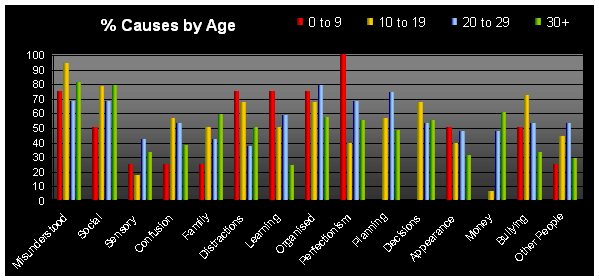
results a bit more interesting to look at I have made graphs that compare
by age and by gender, and while some differences are interesting and look
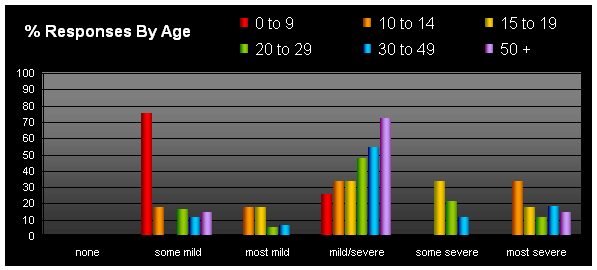
like they might be significant, some are misleading. In particular, only 4
people under the age of 10 took part, so it is not worth comparing them to
the other age groups. Also, the differences that appear between genders
could likely be caused not by any actual gender difference among people
with AS but instead by the gender expectations imposed on them by society.
There are some general
things I can report however from the results. On average most of the
Aspies who responded reported that they were under some degree of stress
most of the time. The causes of stress varied greatly, but the most
commonly reported was being misunderstood. Of the possibly stress related
mental and physical health issues I asked about, most of them were
reported in between 30% to 70% of responses.
How these results would
compare to a survey of neurotypical people I cannot know. We live in a
time when stress and stress related illness are common in all areas of
society. What worries me is that the things that cause stress for Aspies
and the types of things that Aspies need to do to relieve stress are
different to the majority, so our issues are not addressed and there is
nowhere we can turn for help and advice.
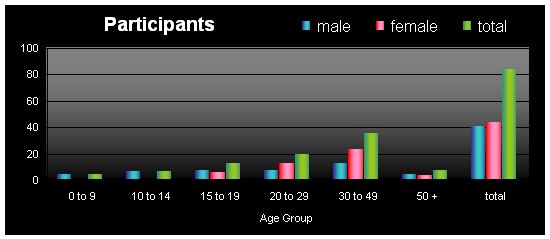
I think it interesting that
more female aspies than male took part, since males outnumber females on
the autistic spectrum by at least 4 to 1.
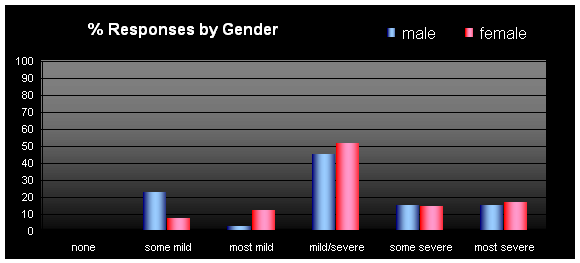
The responses of stress
levels people had to choose from were as follows...
I suffer with severe stress most of the time.
I suffer with severe stress some of the time.
I suffer with mild stress most of the time and
severe stress occasionally.
I suffer with mild stress most of the time.
I suffer with mild stress some of the time.
I never get stressed.
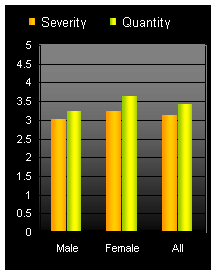
The average stress levels
were calculated by giving the responses offered values from 0 to 5 first
ranked by the severity of stress reported and second by the whether stress
was being experienced just some of the time or most of the time, 0 being
the lowest and 5 the highest.

People were given a list of
15 things and asked to select which of them contributed to any stress they
experienced. The options were... being misunderstood, social situations
and difficulties, Sensory problems, feeling lost and confused, family,
constant distractions, embarrassment at learning difficulties, trouble
getting organised, being a perfectionist, planning for the future, making
decisions, concern about appearance, worrying about money, bullying, and
other peoples problems...
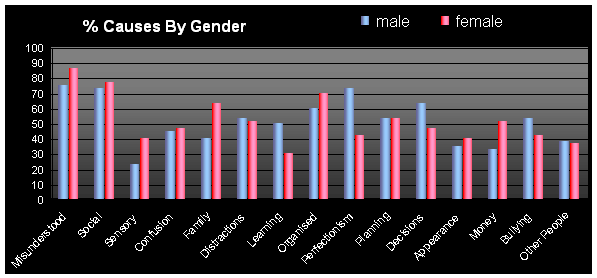
Above and below are graphs
that show the percentage of people in each category that selected
each option e.g. Just over 70% of the males who took part reported that
their perfectionism caused them stress while only just over 40% of the
females who took part did.
People were also given a
list of 19 mental and physical health problems and asked to select which of them
they experienced difficulty with. The options were... skin disorders, eating
disorder/being underweight, obesity/being overweight, headaches,
diarrhoea/constipation, ulcers, sinus problems/colds, infections, muscular
tension, general aches and pains, constant fatigue, allergies/asthma,
sleeping difficulty, thoughts of suicide or despair, nightmares/anxiety
dreams, paranoia, mood swings, and nervous habits e.g. nail biting.
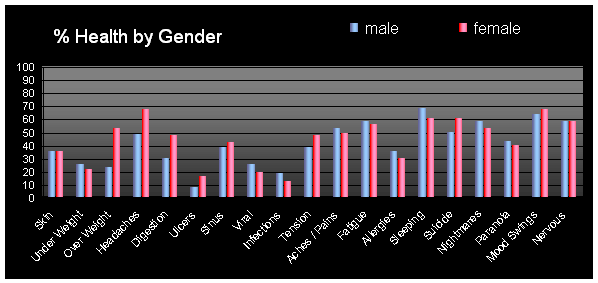
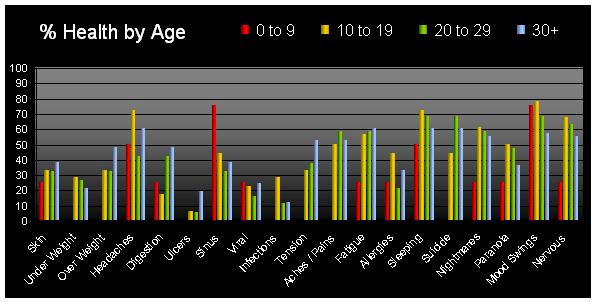
Above and below are graphs
that show the percentage of people in each category that selected
each option e.g. almost 70% of 20 to 29 year olds reported feelings of
suicide or despair.
Contact the author of this feature.
|





