|
Sensory |
Physical |
Mental |
Social |
Emotional |
Communication |
Talents |
Interests |
|
Emotions
|
|
Living with
Stress
|
|
Relaxation |
|
Stress Survey |
|
Depression |
|
Emotions
Contrary to what some people say, people with Asperger
Syndrome do have emotions, but our emotional world does seem somewhat
different to most...
- The way we express emotions may be different.
- The types of things that cause our emotional reactions
may be different.
- Our internal experience of an emotion may be to
different to what other people experience.
- We may attribute subtly different meanings to words
that describe emotions.
I can only really describe this in terms of my own
experience at present...
For example, I know what an embarrassing situation is and I
have learnt the hard way what the consequences of having an embarrassing
thing happen to you are... loss of respect from other people, teasing etc.
and therefore I would rather avoid embarrassing things happening to me. As
far as I can tell though I have never felt an emotion that might be
embarrassment, and yet I use the word all the time as if I do, partly to fit
in and partly because I don't want people to take advantage.
There are
other emotions that I seem to have in
a mental sense but the actual feeling or emotion itself appears to either be
very muted or absent altogether. For example, jealousy... I can want something someone else has, but I don't feel
moved about it with the intensity that other people seem to. When I talk
about experiencing jealousy I am not describing what most people think I am,
I am just using the dictionary definition of a set of circumstances,
probably without actually feeling anything at all.
Another thing is that I don't react
emotionally to other people's emotions. I understand this is quite common
with Asperger's. For example, if someone is crying that doesn't bother me or
make me feel upset at all. Other people can be as dramatic and intense as
they want and I remain unmoved, where as most people seem to get
uncomfortable, embarrassed or upset themselves. This isn't because I don't
care... in fact I find not reacting myself means I can offer far more in the
way of practical and constructive support. I suppose that's not always what
people want, but that is all I have to offer. What is more, I do this
because it is my choice because I want to. From what I have seen of most
other people their empathic responses to other people's emotions merely
compel them to act.
Curiously, hearing about, reading, or
seeing other people suffering, such as in the news, books or films, and I
can't stop myself immediately crying in response, even in public places
where it might not be appropriate. Therefore I can only assume that it is
not empathy I lack, it's just I respond to the situation or event rather
than to another persons emotions.
There are also some emotions that I seem to
feel more intensely than other people. I sometimes joke that I have only two
emotions... off and on, because I always seem to occupy one extreme or
another. I am either deliriously happy and content or I am in the depths of
frustration and despair. I seem to get much more enthusiastic about things
than other people do, and I will pursue a logical argument with passion and
determination worthy of religious fervour. Sometimes I get very frustrated
because of communication difficulties and misunderstandings and I can get
quite irritable and short tempered. When I was a child this would often
manifest as tantrums, and I understand that is also quite common.
It may be that some of these things are
just me and don't apply to everybody with Asperger's. We are a very diverse
bunch. It is certainly fair to say though that emotions are just another
example of how Asperger's can be just a different way of being. |
|
Living with Stress
People with Asperger syndrome can be
particularly vulnerable to stress.
How much stress you have experienced is
traditionally measured by assigning points to particularly stressful events such
as moving house or bereavement, and then totalling up how much stress you have
had during the last year. This system however does not take account of the fact
that 10% of people have low stress tolerance, and require a lot less to happen
before they become stressed. Also, severe stress can just as easily be caused by
a constant build up of minor stresses as it can a few big events or changes.
If you have lived every day of your whole life
under stress you may not even appreciate how much stress you are under because
it just feels normal.
Some examples of things that can cause stress
for people with Asperger syndrome are:
Stress is the bodies response to an event or
situation which is perceived as threatening. In a natural environment stress is
part of the fight or flight response and serves and important purpose. The three
main chemicals that control this response in the body are Noradrenalin,
Adrenaline and Cortisol.
Noradrenalin is your fight
chemical and is related to aggression and anger. When your body produces a large
increase in Noradrenalin in response to something some of the effects it has on
your body include muscle tension, teeth clenching, blood vessels constricting,
hands and feet sweating, and pupils dilating.
Adrenaline is your flight
chemical and is related to escape and running away. When your body produces a
large increase in Adrenaline in response to something some of the effects it has
on the body include heart racing or palpitations, nervous feeling in tummy, cold
sweats, and feelings of insecurity, anxiety, uncertainty, and worry.
Cortisol is your surrender
chemical and is related to loss of control and submission. When your body
produces a large increase in Cortisol in response to something some of the
effects it has on the body include feelings of failure, despair, anxiety and
depression. Large amounts of Cortisol also suppress the immune system.
Excessive, frequent, and prolonged exposure to
the stress response can be harmful to the body. Unlike wild animals we do not
often have the option to physically attack or run away. We don't get that
release. Instead we get miserable and sick. It has been estimated that 75% of
illness reported to GP's is stress related. Stress has been linked with heart
disease, high blood pressure, migraine, indigestion, nausea, heartburn, stomach
ulcers, irritable bowl, diarrhoea, constipation, headaches, neck and back pain,
cancer, arthritis, allergies, colds and flu, asthma, skin disorders, obesity,
anorexia, anxiety, addiction, drug abuse, sleep disorders, and disruption of the
menstrual cycle.
If you see a doctor about stress most of them
will simply offer you tranquilisers, but you should be cautious before resorting
to such things. Even readily distributed prescription drugs can be highly
addictive and have harmful side effects on the central nervous system, cause a
severe deadening of the emotions, alter sleep patterns and reduce the amount of
dream sleep you experience, as well as interact with other every day drugs you
might take in ways you might not want them to.
There are also natural alternative remedies,
but it is hard to get trustworthy and reliable medical advice regarding their
use. It can be very much a case of trial and error, trying to find what works
for you. The only natural remedy I personally found effective against stress was
Kava Kava, but sadly this was made illegal earlier this year on the grounds that
it had not been properly tested as a drug. A rather weak case considering it has
been used safely for thousands of years and at the very least has never be shown
to produce anything like the harmful side effects of prescription tranquilisers,
but there you go.
It is worth remembering that stress
'remedies', be they alternative or mainstream, are not a complete and final
solution to the problem. It is the cause of the stress, not the stress itself,
which ultimately needs to be addressed.
|
|
Relaxation
Mild stress can be reduced by making time for relaxation.
Some of the
things you could do to combat stress include:
-
Making time
for yourself.
-
Meditation
-
Floatation
Tank
-
Relaxing
music
-
Eating well,
avoid chocolate, coffee, cigarettes, alcohol etc.
-
Yoga
-
Massage
-
Having a change of scenery / vacation.
-
Exercise
-
Acupuncture
-
Building a
sensory retreat, such as your bedroom, tailor made to your sensory
requirements, where you can escape to.
-
Aromatherapy
-
Getting
enough quality sleep.
When your stress is severe it may be
impossible to achieve a relaxed state. Sometimes stress gets so bad that you
can't cope and can't be expected to carry on trying to function at an effective
level. This is nothing to be ashamed of and is much more common than you think.
Don't wait until you reach breaking point before you ask for help.
|
|
Stress Survey
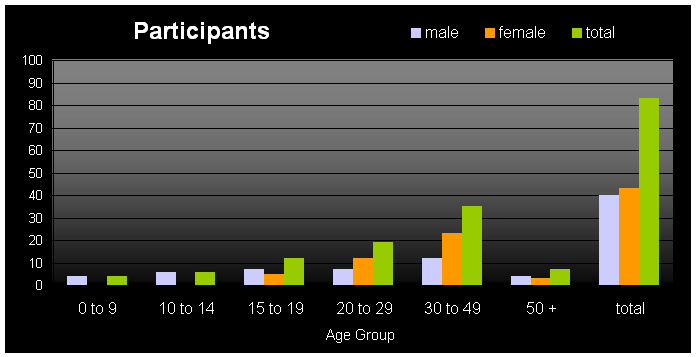
83 people responded to a
stress survey I ran on this site throughout March and April 2003.
It goes without saying that
this survey was far from scientific, and it's purpose was never to prove
anything... It was just a curiosity.
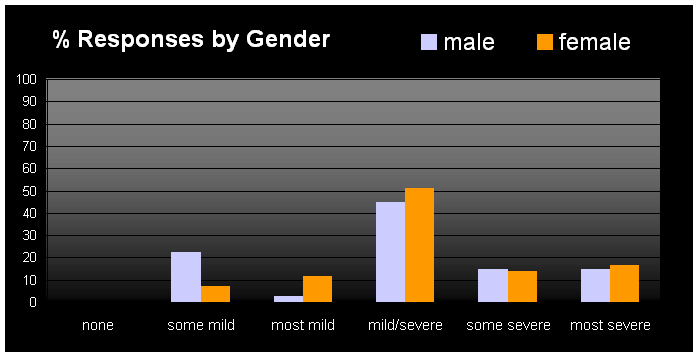
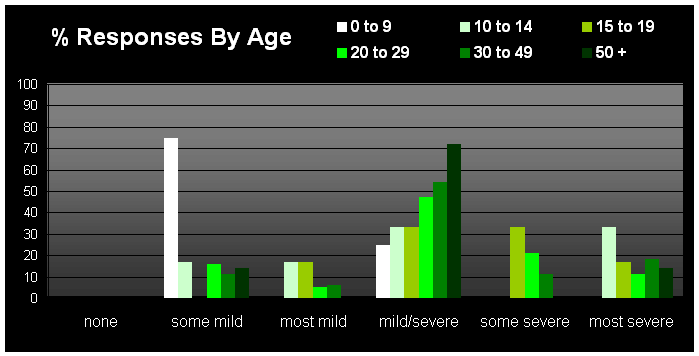
For the sake of making the
results a bit more interesting to look at I have made graphs that compare by age
and by gender, and while some differences are interesting and look like they
might be significant, some are misleading. In particular, only 4 people under
the age of 10 took part, so it is not worth comparing them to the other age
groups. Also, the differences that appear between genders could likely be caused
not by any actual gender difference among people with Asperger syndrome but
instead by the gender expectations imposed on them by society.
The responses of stress levels people had to
choose from were as follows:
-
I suffer with severe stress most of the
time.
-
I suffer with severe stress some of the
time.
-
I suffer with mild stress most of the time
and severe stress occasionally.
-
I suffer with mild stress most of the time.
-
I suffer with mild stress some of the time.
-
I never get stressed.
How these results would
compare to a survey of neurotypical people I cannot know. We live in a time when
stress and stress related illness are common in all areas of society. What
worries me is that some of the things that cause stress for Aspies and the types
of things that Aspies need to do to relieve stress are different to the
majority, so our issues are not addressed and there is nowhere we can turn for
help and advice.
People were given a list of 15 things and asked to select which of them
contributed to any stress they experienced. The options, and the total
percentage of participants who said they were a cause of stress for them, were
as follows.
-
Being misunderstood - 81%
-
Social situations and difficulties - 75%
-
Trouble getting organised - 65%
-
Being a perfectionist - 58%
-
Making decisions - 55%
-
Planning for the future - 53%
-
Family - 52%
-
Constant distractions - 52%
-
Bullying - 48%
-
Feeling lost and confused - 46%
-
Worrying about money - 42%
-
Embarrassment at learning difficulties - 40%
-
Concern about appearance - 38%
-
Other peoples problems - 38%
-
Sensory problems - 32%
On average most of the Aspies who responded
reported that they were under some degree of stress most of the time. The causes
of stress varied greatly, but the most commonly reported was being
misunderstood, with social difficulties coming a close second.
Sensory problems were the least commonly reported source of stress, but that
was still 1 in 3 people saying they were.
-
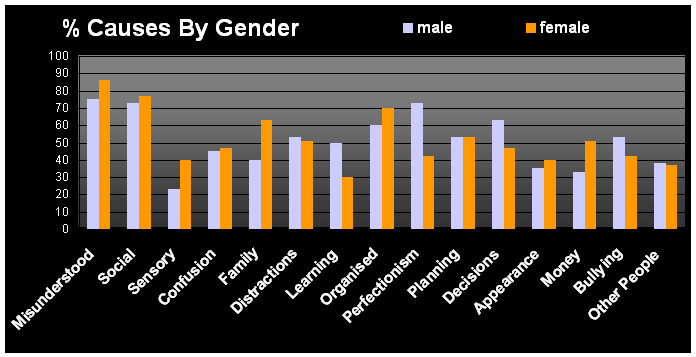
40% of females said sensory problems were a cause of
stress but only 23% of males did.
-
63% of females said that family life caused them
stress but only 40% of males did.
-
50% of males said that embarrassment at learning
difficulties was a source of stress for them, but only 30% of females
did.
-
73% of males said their own perfectionism caused
them stress, but only 42% of females did.
-
63% of males said having to make decisions
contributed to stress, but only 47% of females did.
-
51% of females said money worries caused them
stress, but only 33% of males did.
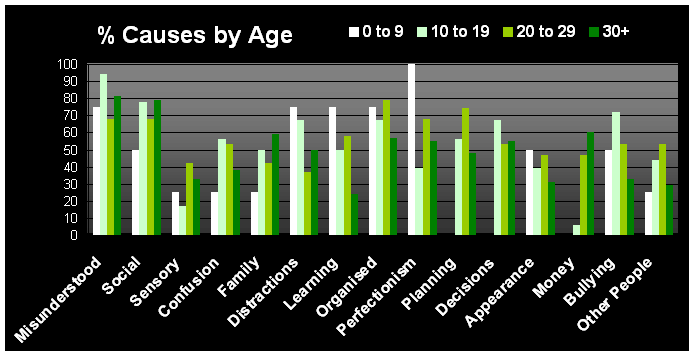
Looking at the reported causes of stress by age group the general trend reflects
the lifestyle changes that come with growing older. Younger people are more
likely to report bullying and learning difficulties cause them stress, and
older people are more concerned by money and family. Planning for the
future is of more concern for people in their 20's and true to form, 94 % of
10-19 year olds were stressed out at being misunderstood.
Interestingly, around 70% of people under 20 listed constant distractions as a source
of stress, and that sort of information could be taken into consideration when
planning and organising school and home life.
|
|
Depression
People with Asperger syndrome are vulnerable to clinical depression because of the stress,
isolation and victimisation we sometimes experience, and there is a
possibility we have a pre-disposition to it, but I don't think that means we
are inevitably and inescapably depressed all the time. Speaking for myself,
I've had clinical depression... it came and it went. Some people could
interpret the way I am now as mildly depressed at times, but no where near
in the same league. As I write this I feel perfectly calm and content and
even quite happy because I am doing something I enjoy... it is a Sunday
morning and the sun in shining and life is good. If you are depressed you
cannot feel emotions like these. When you are depressed everything just
feels... dead.
Depression is a clinical condition caused by a
neurochemical or hormonal imbalance. It is not the same as self pity, just
feeling a bit down or going through a bad patch. When the brain responds to
upset and trauma in a healthy way it works its way through the experience
and recovers. Sometimes the brain gets sort of stuck and doesn't get better
like it should. It could start off having been a healthy response to
something bad that happened or is happening, or it may occur without
anything obviously bad having happened at all. In a way, the mind gets in a
loop of negative thinking... you can't see beyond the way you are feeling
and the future just seems black. You might be able to sense that your
feelings are out of proportion to the circumstances, but you can not shake
it off and cheer up. This just makes you feel guilty, and feeds the self
hate that can become the driving force of depression.
Some of the symptoms of depression include:
- You have feelings of misery and despair.
- You feel like you hate yourself.
- You lack energy.
- You lack motivation.
- You suffer from stress, anxiety, or feelings of panic.
- You don't feel like socialising.
- You find it hard to concentrate or think clearly.
- You feel guilty.
- You feel like a failure.
- You think you are evil.
- You feel like a burden to others.
- You sometimes feel that life isn't worth living.
- You see the future as black and hopeless.
- You feel like everything is futile and can't find
pleasure in anything.
- You feel irritable or angry more than usual.
- You lack confidence.
- You may go over and over the past and things that you
feel went wrong, often blaming yourself.
- You feel that life is unfair.
- You are having difficulty sleeping and may be troubled
by nightmares or anxiety dreams.
- You may be crying a lot.
- You may have aches and pains.
- You may be off sex.
- You may be off food and losing weight, or comfort
eating and gaining weight.
- You feel like you hate your body, feel disgusting or
imagine that you are rotting.
- You feel like you are dead.
- You might be hurting yourself.
- You may be contemplating suicide.
If you think that you might have depression then you
should make an appointment to see your doctor. They will usually offer you
anti-depressants or counselling or both.
I last took anti-depressants 10 years ago and they did not
agree with me much. Autistic people can be very sensitive to medications and
react to them in unusual ways. While I was on them I had no personality and
I was a giggling idiot. It felt like I was lost inside a cloud. They took
away the pain of the despair, but they took the rest of me away with it.
When I tried to come off them I fell straight back into severe, almost
hysterical depression in just a matter of weeks, and then it took
months before my mood levelled out again, with me most certainly hitting
rock bottom before I started to make my way back up. The only reason I
didn't go immediately back on the tablets was because I was in such a state
in didn't even occur to me. In retrospect, taking the little red pills was
just postponing dealing with how I felt, but I can't know for certain I
would have survived without them at the time. I always said I wouldn't take
anti-depressants again unless it was an emergency. Recently I faced such an
emergency and was put on Prozac. It hasn't been too bad and they have
certainly helped me get my life back on track. Taking tablets is never the
ideal but they can help sometimes.
There are other options like counselling and alternative
medicine. If something isn't working for you don't be afraid to say. It is
also very important that you tell who ever you see that you have Asperger
syndrome or think you do, if that is the case.
If you just need someone to talk to then you can contact
The
Samaritans in the UK on 08457 90 90 90. They will listen
to you and take you seriously, but won't get emotionally involved like your
family or friends. You may be surprised by just how helpful that is. |
|
Further reading available from
Amazon.com or
Amazon.co.uk |
|
Sensory |
Physical |
Mental |
Social |
Emotional |
Communication |
Talents |
Interests |
|


